-
07 Oct, 2026
The Publisher's Guide to Surviving a Google Algorithm Update Without Losing Ad Revenue
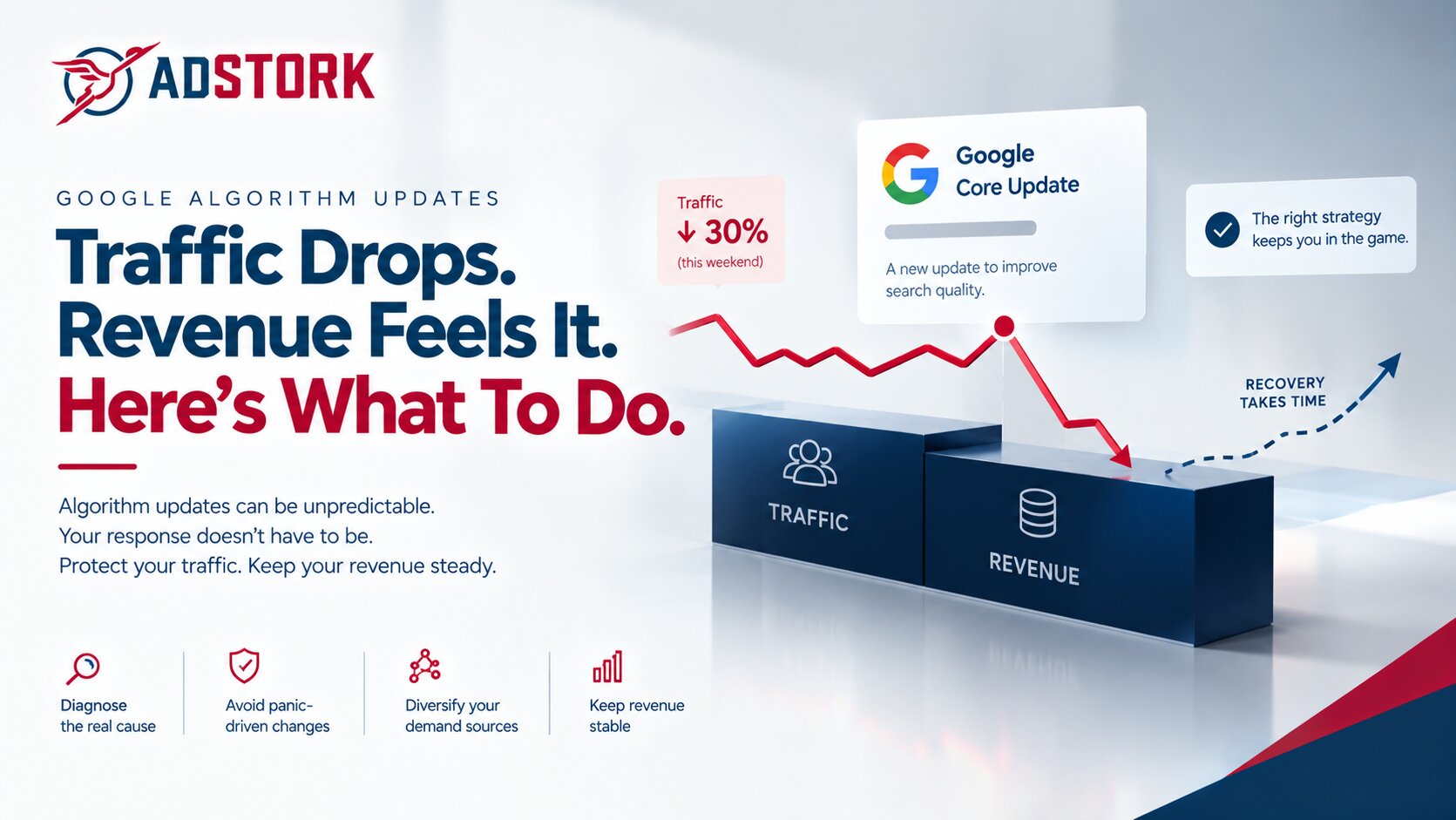
Traffic drops 30% over a weekend. No code changed, no content was removed, nothing on the site is different. Then the news breaks: Google rolled out a core update. The explanation arrives, but the revenue is already gone for the month.Algorithm updates are one of the few genuinely uncontrollable forces in a publisher's business. The response to them, however, is controllable, and most publishers respond badly in ways that make the financial impact worse than it needs to be.In short: Google algorithm updates can cause sudden traffic volatility that directly impacts ad revenue, but the publishers who recover fastest are the ones who diagnose correctly before reacting, avoid panic-driven content purges, and have a monetization setup resilient enough to absorb a temporary traffic dip without compounding the damage.Key TakeawaysMost traffic drops attributed to "an update" are not actually related to the update at all.Panic-driven content deletion often does more damage than the update itself.Revenue diversification across multiple demand sources softens the financial impact of a traffic dip.Recovery typically takes weeks to months, not days, and rushing the process usually backfires.1. First, Confirm It's Actually the UpdateTraffic drops coincide with update rollouts often enough that publishers assume correlation automatically means causation. Before reacting, check Google Search Console for manual actions, confirm the drop lines up precisely with the rollout date rather than starting days before it, and compare against industry chatter to see if other sites in the same space reported similar timing. A drop that started a week before the update was announced is probably not about the update.2. The Panic Response That Makes Things WorseThe most common reaction, mass-deleting or drastically rewriting content within days of a drop, is usually premature. Core updates take time to fully roll out and for rankings to settle, often several weeks. Making large structural changes mid-rollout means a publisher cannot tell whether a change helped, hurt, or had no effect at all, because the update itself is still moving the baseline underneath them.3. Protecting Revenue While Traffic RecoversDon't cut ad density during the dip. It is tempting to assume fewer ads will help recovery somehow. It will not affect rankings, and it compounds the revenue loss unnecessarily.Check whether the remaining traffic shifted in value. Sometimes an update changes which pages rank, shifting traffic toward lower or higher commercial-intent content than before, which affects RPM independent of volume.Lean on non-search channels temporarily. Direct, email, and social traffic are unaffected by the update and can partially offset the gap while rankings stabilize.4. Where Adstork Fits InA single-network setup with one fixed buyer has no flexibility to absorb a sudden volume change. Adstork's multiple competing demand sources mean that whatever traffic does arrive during a volatile period is still being exposed to real competition for the best possible rate, rather than a fixed, pre-negotiated price that doesn't adjust to changing conditions.5. Being Honest About Recovery TimelinesSome sites recover fully within the same update cycle. Others don't recover for months, or ever, if the update reflected a genuine, lasting shift in what Google considers quality for that content type. There is no guaranteed timeline, and any claim promising one should be treated skeptically.Panic Response vs. Measured ResponseActionPanic ResponseMeasured ResponseContentMass delete/rewrite within daysWait for full rollout, then diagnoseAd densityCut immediatelyLeave unchangedTraffic channelsIgnoredLean on email/direct/socialFinal WordAlgorithm updates are uncontrollable. The response to them is not, and a measured response protects both long-term rankings and short-term revenue far better than panic does. At Adstork Ad Network, competing demand sources mean whatever traffic a site has during a volatile period is still earning what it's actually worth.Ready for a monetization setup that holds steady through SEO volatility? Partner with Adstork Ad Network today.FAQsHow long does it take to recover from a core update? It varies widely, from weeks to several months, and some sites never fully recover if the update reflects a lasting quality shift rather than a temporary fluctuation.Should I delete content that dropped in rankings? Not immediately. Wait for the update to fully roll out and diagnose the actual cause before making structural changes.Does reducing ads help SEO recovery? No. Ad density does not directly affect core update recovery and cutting it only compounds revenue loss unnecessarily.Suggested Internal LinksWhy Does One Website Keep Growing While a Similar Website Stays Stuck?What Happens to Ad Revenue During Major Traffic Events?
Read More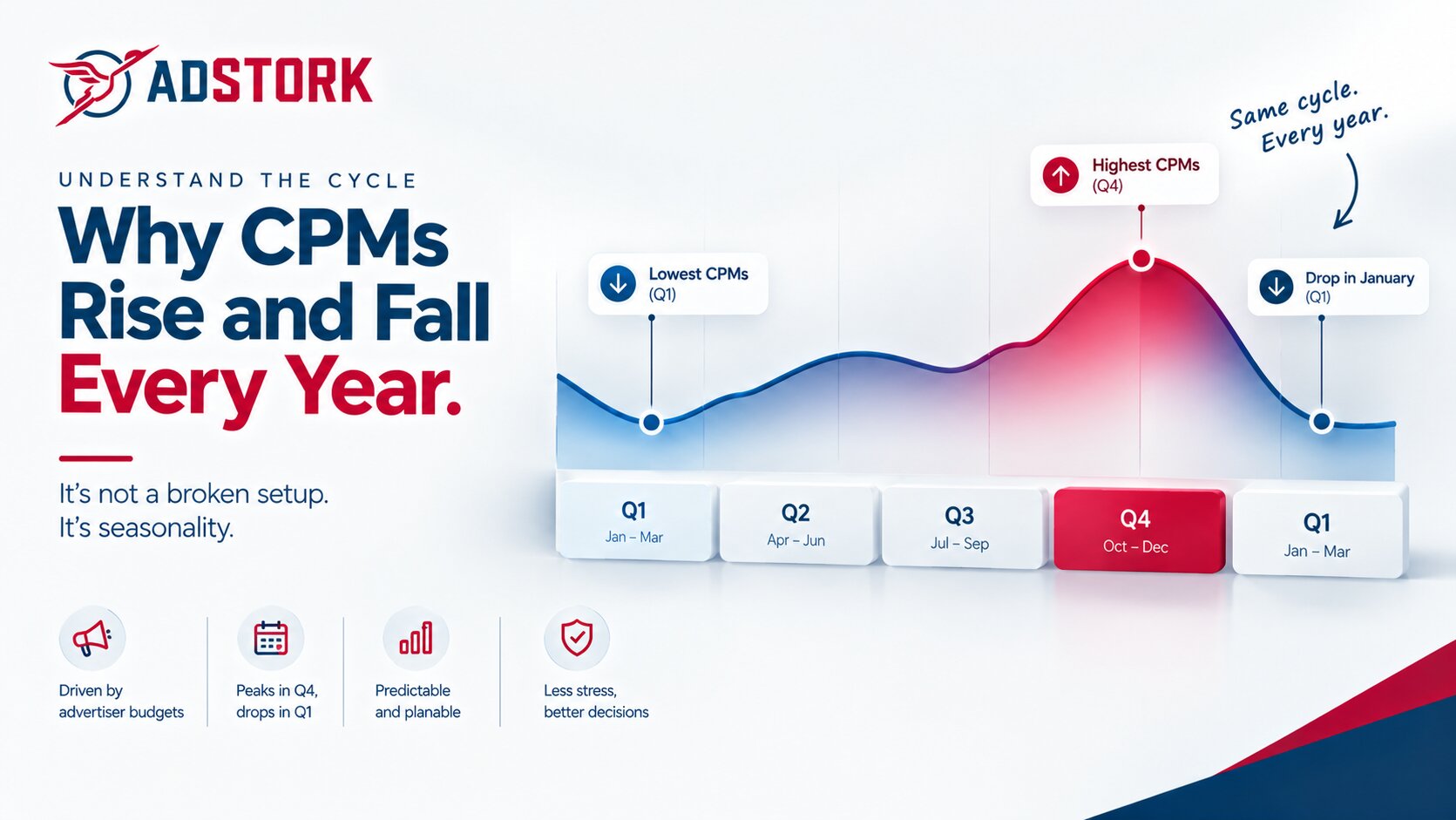
-
07 Oct, 2026
How Seasonal CPM Swings Work: Why Your Rates Drop in January and Spike in November
Every January, the same message appears in publisher communities: "Did something break? My CPM just fell off a cliff." Every November, the opposite message appears: "CPMs are amazing right now, what changed?"Nothing broke in January, and nothing special happened in November beyond the calendar. Both are the same predictable cycle repeating every year, and understanding it removes a lot of unnecessary anxiety.In short: CPMs follow a predictable annual cycle driven by advertiser budget timing, peaking in Q4 around holiday shopping season and dropping in January as new annual budgets restart at lower initial spend. Recognizing this pattern prevents publishers from mistaking normal seasonality for a broken setup.Key TakeawaysCPM seasonality is driven by advertiser budget cycles, not changes in a publisher's own setup.Q4 typically delivers the highest CPMs of the year, Q1 typically the lowest.The swing is predictable enough to plan content and cash flow around.1. The Annual Budget Cycle, ExplainedMost advertisers plan and allocate budgets annually, often with a disproportionate share pushed into Q4 to capture holiday shopping demand. Retail, e-commerce, and consumer brands compete intensely for inventory from October through December, bidding up prices across the board. Once the calendar resets in January, new annual budgets have just been approved but spending typically ramps slowly, since campaigns need to be planned and launched before dollars actually flow into bids.2. The Typical Shape of the YearQ1 (Jan-Mar): Lowest CPMs of the year, slow ramp as new budgets get planned.Q2-Q3 (Apr-Sep): Steady, moderate CPMs as campaigns run at normal pace.Q4 (Oct-Dec): Highest CPMs, driven by holiday shopping competition, peaking around Black Friday and Cyber Monday specifically.3. How to Plan Around the CycleTreat Q1 revenue dips as expected rather than alarming, and avoid making reactive changes to the ad setup based on a seasonal dip alone. For cash flow planning, the gap between Q4 peak earnings and Q1 trough earnings can be significant, smoothing income across the year, or budgeting conservatively based on Q1-level revenue, prevents surprises.4. Where Adstork Fits InCompeting demand sources help soften, though not eliminate, the Q1 trough, since a broader pool of advertisers means a better chance of finding whatever demand is active even during slower months. Transparent reporting also helps publishers distinguish a normal seasonal dip from an actual setup problem, rather than guessing.5. When It's Not Just SeasonalitySeasonality explains a predictable, proportional dip. It does not explain a dip far steeper than prior years, or one that doesn't recover by Q2. If a January drop is dramatically worse than the same period last year, something beyond normal seasonality is worth investigating.Typical Quarterly CPM PatternQuarterTypical CPM TrendQ1Lowest, slow budget rampQ2-Q3Steady, moderateQ4Highest, holiday competitionFinal WordCPM seasonality is predictable, not a sign of a broken setup. Planning around it, rather than reacting to it, saves both stress and unnecessary changes. At Adstork Ad Network, competing demand helps soften the Q1 trough while transparent reporting shows exactly what's seasonal and what isn't.Ready for a setup that holds steady through the seasonal cycle? Partner with Adstork Ad Network today.FAQsWhy does my CPM drop every January? New annual advertiser budgets take time to ramp into active spending, while Q4 holiday competition that drove rates up has ended.When is CPM typically highest during the year? Q4, usually peaking around Black Friday and Cyber Monday, driven by retail and e-commerce competition for holiday shopping traffic.How do I know if a CPM drop is seasonal or a real problem? Compare the drop's severity against the same period in prior years. A proportional, predictable dip is seasonal. A dip far steeper than usual warrants investigation.Suggested Internal LinksWhat Happens to Ad Revenue During Major Traffic Events?The RPM Benchmark Report: What Publishers Actually Earn by Niche
Read More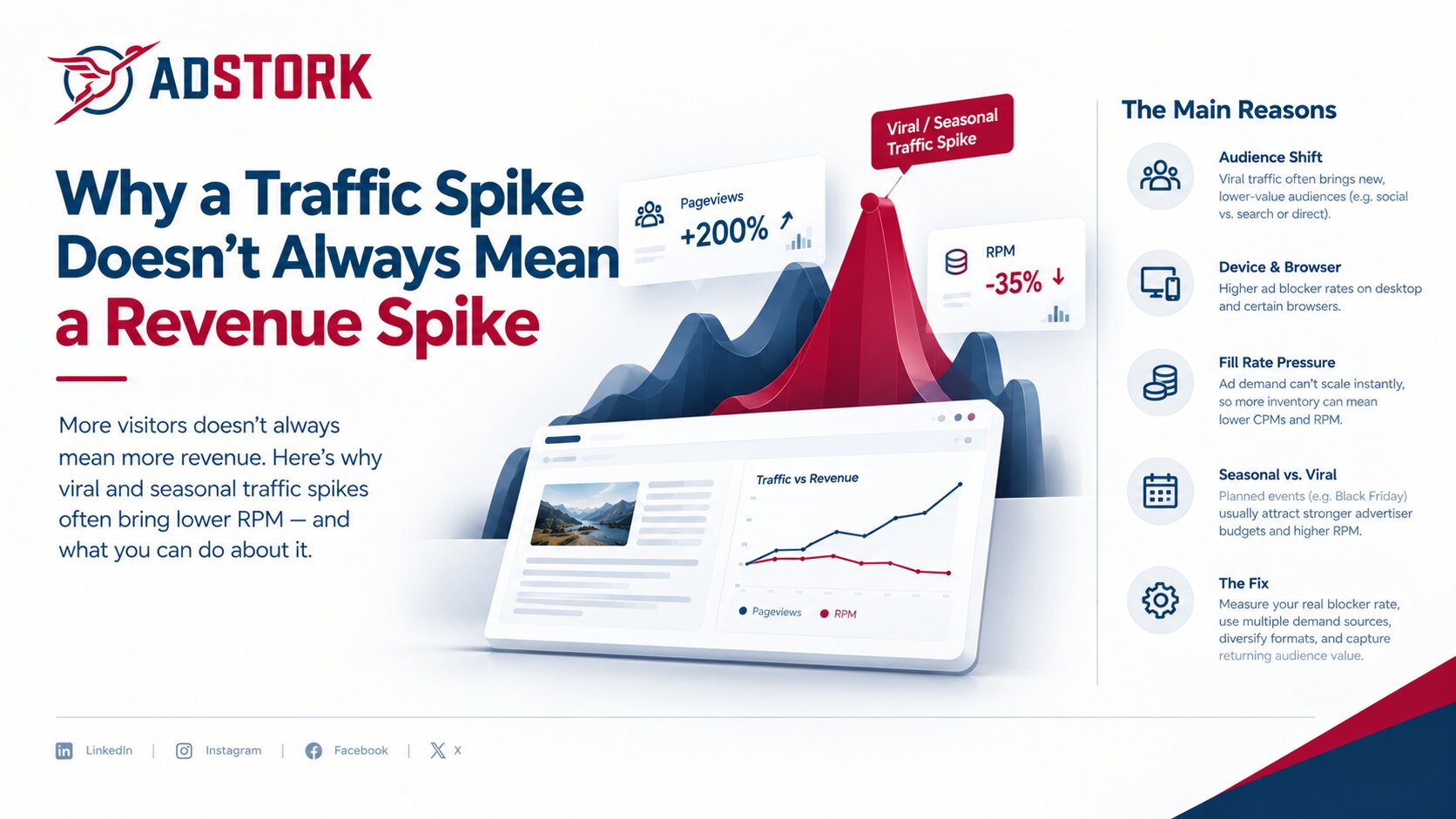
-
05 Oct, 2026
What Happens to Ad Revenue During Major Traffic Events (And Why It's Not Always Good)
A post goes viral. Traffic triples overnight. The publisher checks their revenue dashboard expecting a matching spike, and instead finds RPM quietly dropping while pageviews climb. The excitement of a traffic surge turns into confusion within a day.This happens often enough that it deserves an explanation beyond "sometimes that's just how it goes." There are specific, predictable reasons a traffic spike does not translate into a proportional revenue spike, and understanding them changes how a publisher should actually prepare for one.In short: Sudden traffic surges, whether from viral content, breaking news, or seasonal shopping events, often monetize at a lower RPM than normal traffic because of changes in audience composition, fill rate pressure, and advertiser budget timing. Understanding why prevents publishers from misreading a successful traffic event as a broken ad setup.Key TakeawaysTraffic spikes often bring in lower-value audience segments than a site's normal baseline traffic.Sudden volume increases can outpace demand, dropping fill rate and effective CPM at exactly the moment a publisher expects the opposite.Seasonal events like Black Friday behave differently from viral spikes because advertiser budgets are deliberately concentrated around them.A traffic spike is a one-time event unless a publisher has a plan to convert part of it into returning audience.1. Why Viral Traffic Often Monetizes Worse Than Normal TrafficA viral spike usually arrives through a different channel than a site's normal traffic, often social sharing rather than search or direct visits. That shift in traffic source matters more than most publishers realize. Social traffic typically converts to ad revenue at a meaningfully lower rate than search or direct traffic, partly because these visitors tend to read one page and leave rather than exploring further, and partly because advertisers assign lower value to audiences arriving through social referral compared to audiences who sought the content out directly.The visitors are also frequently new to the site, meaning there is no return-visit history, no prior engagement signal, and often a different geographic mix than the site's usual audience, sometimes skewing toward regions that command lower CPMs.2. The Fill Rate Problem Nobody Warns Publishers AboutAd demand is not infinite and does not scale instantly. A site that triples its traffic overnight also triples its ad requests, but the number of advertisers bidding on that inventory does not triple along with it. The result is a sudden gap between supply and demand, where impressions that would normally fill at a healthy rate go partially unsold or get filled at much lower backup rates.This is one of the more counterintuitive mechanics in programmatic advertising. More inventory, arriving faster than demand can absorb it, often results in a lower average price per impression, not a higher one.3. Why Seasonal Events Behave Differently From Viral SpikesBlack Friday, the holiday shopping season, and similar planned events are a different situation entirely. Unlike a random viral spike, advertisers know these events are coming and deliberately concentrate budget around them months in advance. This means demand actually does scale up to meet the seasonal traffic increase, and CPMs during these windows often rise rather than fall, sometimes significantly, because retail and e-commerce advertisers are competing hard for exactly this kind of commercial-intent attention.The distinction matters: a publisher should expect a viral spike to compress RPM, and a well-timed seasonal spike to expand it, assuming their content and audience are relevant to what advertisers are spending on that season.4. What Publishers Can Actually Do to PrepareSet expectations before the event, not after. Knowing in advance that RPM typically dips during a viral spike prevents a false alarm that leads to unnecessary setup changes mid-surge.Use multiple competing demand sources. A setup with several demand sources bidding simultaneously absorbs sudden volume increases far better than a single-buyer setup, since there are more potential bidders to catch the overflow inventory.Capture the spike for later, not just now. A newsletter signup prompt or a simple on-page nudge during a traffic surge can convert a fraction of one-time visitors into a returning audience, turning a single event into compounding value.Plan seasonal content ahead of the demand curve. For predictable events like Black Friday, publishing relevant content weeks in advance lets it rank and accumulate traffic before the highest-CPM window actually arrives.5. Where Adstork Fits InSudden traffic surges are exactly where a single fixed-rate network setup shows its limits. Adstork connects publishers to multiple competing demand sources simultaneously, which means a sudden volume increase has more places to find a bid rather than overwhelming one buyer's limited demand. For planned seasonal events, this also means publishers are positioned to capture rising advertiser budgets rather than being capped by whatever one network decided to allocate.6. Being Honest About the LimitsNo setup fully eliminates the RPM dip that comes with a sudden, unplanned viral spike. The audience composition problem, new visitors with no engagement history, often arriving from lower-value channels, is structural, not a technical issue a network can fully solve. The realistic goal is softening the dip and capturing lasting value from the event, not preventing the dip entirely.Viral Spike vs. Seasonal SpikeFactorViral SpikeSeasonal Spike (e.g. Black Friday)Advertiser demandUnprepared, lags behind supplyPre-planned, scales with trafficTypical RPM impactDecreasesOften increasesAudience qualityOften new, low engagement historyMix of returning and new, commercial intentPredictabilityLow, hard to prepare forHigh, can be planned months aheadWhat's Next for Traffic Spike MonetizationAs AI-driven traffic patterns continue to shift how and when surges happen, including sudden spikes from being cited in AI answer engines, publishers who already have multiple demand sources and audience-capture mechanisms in place will be far better positioned to monetize unpredictable traffic events than those relying on a single, slower-to-adapt setup.Final WordA traffic spike is not automatically a revenue spike, and understanding why prevents a publisher from panicking over a dashboard that is behaving exactly as expected. At Adstork Ad Network, multiple competing demand sources help absorb sudden volume increases and capture rising seasonal budgets, so publishers get the most realistic outcome a given traffic event can actually produce.Ready for a setup built to handle traffic surges, not just steady-state traffic? Partner with Adstork Ad Network today.FAQsWhy did my RPM drop when my traffic went viral? Viral traffic often arrives through lower-converting channels like social media, comes from new visitors with no engagement history, and can outpace advertiser demand, all of which push RPM down even as pageviews rise.Does Black Friday traffic monetize better than normal traffic? Often yes, because advertisers plan and concentrate budget specifically around seasonal shopping events, unlike an unplanned viral spike where demand has not prepared for the surge.Can I prevent RPM from dropping during a traffic spike? Not entirely, but using multiple competing demand sources and capturing part of the spike into a returning audience, such as through newsletter signups, softens the impact and extends the event's value.Why does fill rate drop during high-traffic moments? Advertiser demand does not scale instantly. A sudden increase in ad requests can outpace the number of advertisers actively bidding, leaving some inventory unfilled or filled at lower backup rates.Should I prepare content in advance for seasonal traffic events? Yes. Publishing relevant content weeks ahead of events like Black Friday allows it to rank and build traffic before the highest-demand window arrives.How does Adstork help during sudden traffic increases? By connecting publishers to multiple competing demand sources simultaneously, which absorbs sudden volume spikes better than relying on a single buyer's limited demand.Suggested Internal LinksWhy Does One Website Keep Growing While a Similar Website Stays Stuck?Should Established Publishers Add Another Ad Network?The RPM Benchmark Report: What Publishers Actually Earn by Niche
Read More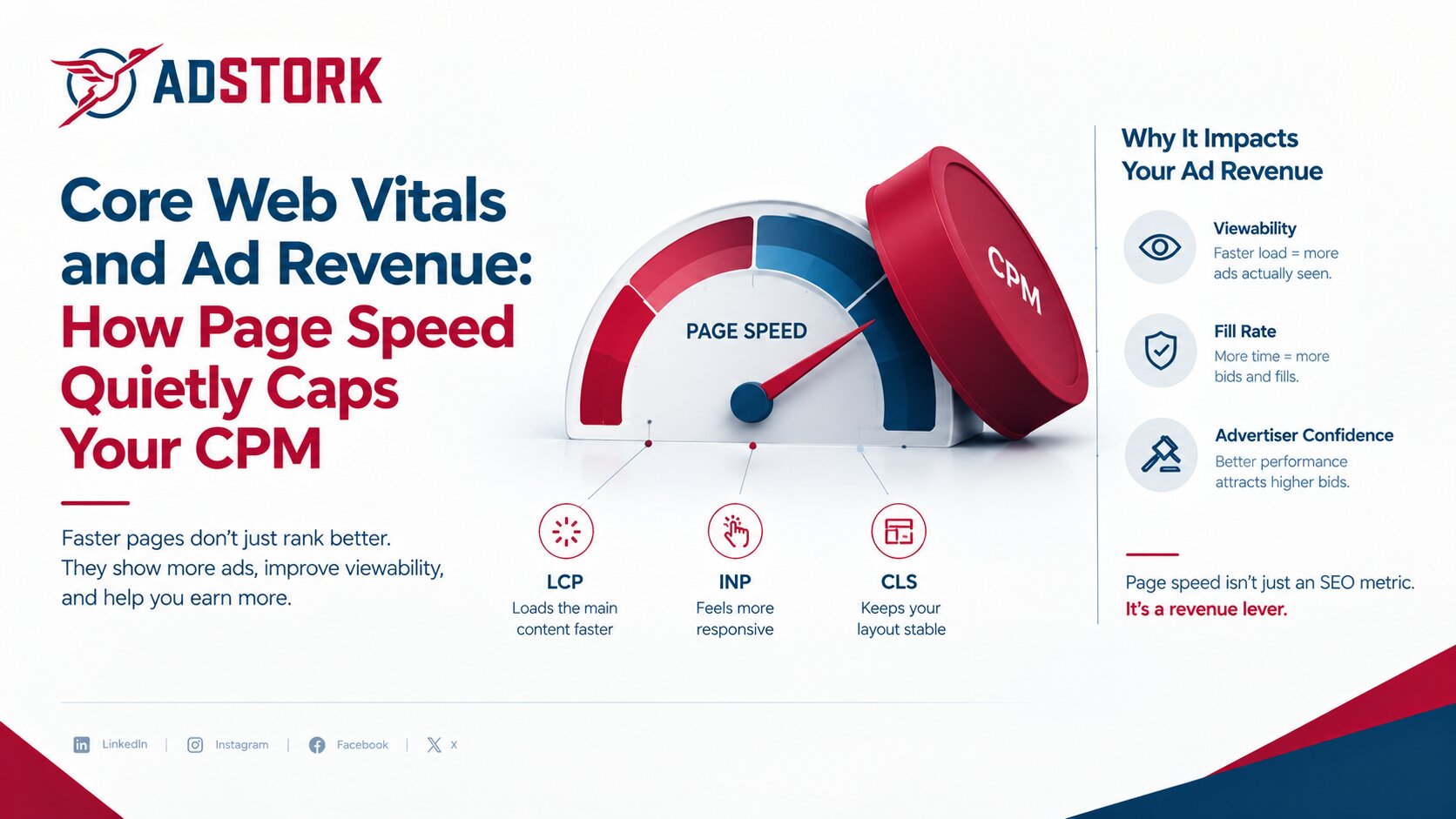
-
05 Oct, 2026
Core Web Vitals and Ad Revenue: How Page Speed Quietly Caps Your CPM
Most publishers treat page speed as an SEO issue. Something to fix because Google says so, filed under technical maintenance rather than revenue strategy. That framing misses half the picture.A slow page does not just rank worse. It serves ads worse, shows them less often, and gets paid less for the ones it does show. The connection between page speed and ad revenue is direct, measurable, and usually invisible until someone goes looking for it.In short: Core Web Vitals, the metrics Google uses to measure page experience, directly affect ad revenue through viewability, ad load success rate, and advertiser bid confidence. A page that loads slowly serves fewer viewable impressions and attracts lower bids, regardless of how good the content or traffic quality is.Key TakeawaysCore Web Vitals are not just an SEO metric. They directly influence viewability and ad fill success.Ad scripts are frequently the single largest contributor to a page's own slowness, creating a feedback loop.A user who leaves before a page finishes loading often never saw the ad at all, meaning it was never truly an impression.Lazy loading and smarter script management can improve both speed and revenue simultaneously.1. The Three Metrics That Actually MatterLargest Contentful Paint (LCP): How long it takes the main content to become visible. A slow LCP means ads positioned near that content also load late, or users leave before either renders.Interaction to Next Paint (INP): How responsive the page feels when a user actually interacts with it. A page that feels sluggish discourages scrolling, which directly reduces how many ad units a user ever reaches.Cumulative Layout Shift (CLS): How much content jumps around as the page loads. Ads are one of the most common causes of layout shift, and a user who accidentally clicks an ad because the page jumped is not a genuine engagement, it is a frustrated visitor and a wasted impression.2. The Feedback Loop Most Publishers Never NoticeAd tech is frequently one of the heaviest contributors to a page's own load time. Ad scripts, tracking pixels, and third-party tags can each add meaningful weight and network requests before a single ad even renders. The irony is direct: the very ads meant to generate revenue are often what slows the page down enough to suppress that same revenue.This creates a quiet feedback loop. A heavier ad setup slows the page. A slower page reduces the chance a user sticks around long enough to see later ad units. Fewer viewed impressions mean lower reported viewability. Lower viewability means advertisers bid less on that inventory going forward. The publisher adds more ad density to compensate, which slows the page further.3. Why Viewability Is the Real Connection PointAn ad that technically loaded but was never actually seen by a user still counts as a served impression in some reporting, but advertisers increasingly pay based on viewable impressions specifically, meaning the ad was actually visible on screen for a meaningful duration. A slow-loading page directly reduces this number in two ways: users leave before scrolling far enough to see lower placements, and ads that do load may render after the user has already moved on or left the page entirely.Advertisers track viewability rates by publisher over time. A site with consistently low viewability gets bid down, even if the content and traffic are genuinely strong, because the advertiser's own data says the impressions aren't reliably being seen.4. Fixes That Improve Both Speed and Revenue TogetherLazy load ads below the fold. Ads only load as a user scrolls near them, rather than all loading at once on page load. This reduces initial page weight while still delivering every placement to users who actually reach it.Reserve ad space in advance. Defining a fixed size for each ad slot before it loads prevents the layout shift that happens when an ad suddenly appears and pushes content around.Limit the number of simultaneous demand calls on initial load. Not every ad unit needs to fire the instant the page opens. Staggering requests based on what is actually visible reduces the initial network burden.Audit third-party scripts regularly. Tracking pixels and tags accumulate over time as new tools get added and old ones rarely get removed. A periodic audit often finds scripts nobody remembers adding, still loading on every page.5. Where Adstork Fits InThis is a specific area where the ad network itself matters, not just the publisher's own site code. A network running inefficient ad delivery can undo a publisher's entire page speed optimization effort in one script tag. Adstork's delivery is built to support lazy loading and reserved ad space without fighting against a publisher's own speed optimizations, and transparent reporting lets publishers see viewability by placement, so a specific slow-loading or high-shift ad unit can be identified and fixed rather than guessed at.6. Being Honest About the Trade-offThere is a real tension between ad density and page speed, and no technical fix eliminates it entirely. More ad units mean more scripts, more network requests, and more potential for layout shift, regardless of how well they are implemented. The realistic goal is not zero impact, it is minimizing unnecessary weight, like redundant tracking scripts or non-lazy-loaded below-fold ads, while accepting that some speed cost comes with any monetization setup.Fast Page vs. Slow Page: The Revenue DifferenceFactorFast Page (Good Core Web Vitals)Slow Page (Poor Core Web Vitals)Viewability70%+Below 50%Bounce before ad loadsLowHighAdvertiser bid confidenceHigherDiscountedAccidental clicks from layout shiftMinimalCommon, damages trustWhat's Next for Page Speed and MonetizationAs Google continues weighting page experience in both search ranking and as AI-driven search tools increasingly evaluate page quality before citing or summarizing content, the publishers who treat speed as a revenue lever rather than a compliance checkbox will have an advantage on two fronts at once, visibility and monetization, rather than just one.Final WordPage speed is not separate from ad revenue, it is one of the quieter levers controlling it. Viewability, fill rate, and advertiser bid confidence all trace back, at least partly, to how fast a page actually loads. At Adstork Ad Network, delivery is built to support speed-friendly practices like lazy loading, so publishers are not forced to choose between a fast site and a monetized one.Ready for an ad setup that works with your page speed instead of against it? Partner with Adstork Ad Network today.FAQsDo Core Web Vitals really affect ad revenue, or just SEO rankings? Both. Slow pages reduce viewability and increase bounce before ads render, which directly suppresses advertiser bid confidence and overall revenue, separate from any SEO ranking impact.What is viewability and why does it matter for CPM? Viewability measures whether an ad was actually visible on screen long enough to count as genuinely seen. Advertisers increasingly pay based on viewable impressions, so low viewability directly reduces what they're willing to bid.Do ads themselves slow down a page? Often significantly. Ad scripts, tracking pixels, and third-party tags can each add meaningful load weight, sometimes becoming the single largest contributor to a page's overall slowness.What is lazy loading and how does it help? Lazy loading delays an ad from loading until a user scrolls near it, rather than loading every ad unit immediately. This reduces initial page weight while still serving every placement to users who reach it.Can I fix layout shift caused by ads? Yes, by reserving a fixed size for each ad slot in the page's code before the ad actually loads, preventing surrounding content from jumping when the ad appears.How does Adstork support page speed optimization? Delivery is built to work with lazy loading and reserved ad space, and transparent reporting shows viewability by placement so slow or high-shift ad units can be identified and fixed.Suggested Internal LinksHow Many Ads Should a Website Have?What Makes a Website Valuable to Advertisers?Why Ad Blockers Aren't the Revenue Killer Publishers Think They Are
Read More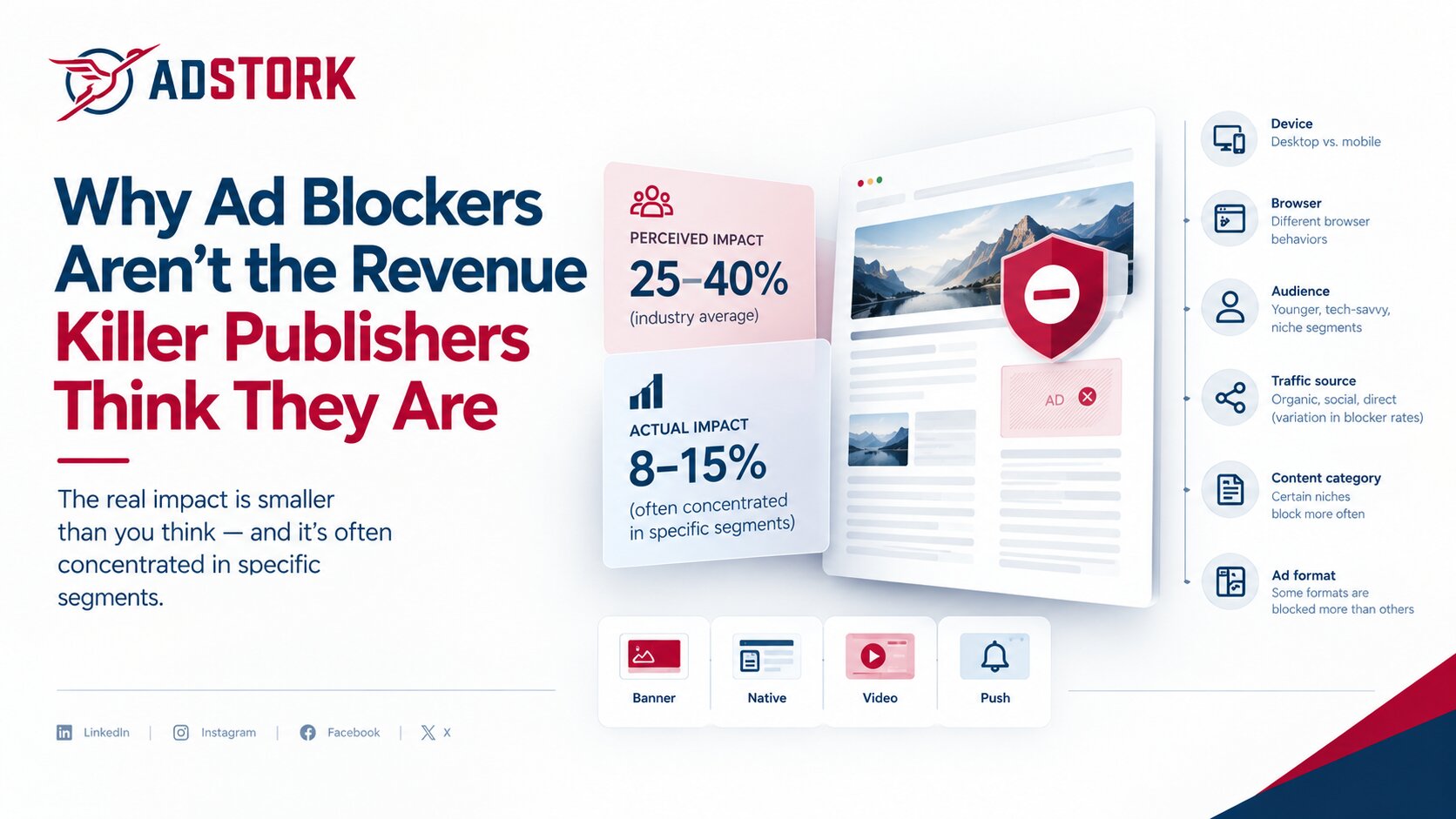
-
05 Oct, 2026
Why Ad Blockers Aren't the Revenue Killer Publishers Think They Are
Check any publisher forum and you will find the same anxiety repeated in different words: ad blockers are eating revenue, adoption keeps climbing, and there is nothing to do about it except watch the dashboard slowly decline. It is treated as an unstoppable force, something publishers simply absorb.That framing is mostly wrong. Ad blocker usage is real, but the revenue impact on most sites is smaller than assumed, and a meaningful share of it is recoverable.In short: Ad blockers affect a real but often overstated share of publisher traffic, typically concentrated in specific audience segments rather than evenly spread across a site. Acceptable ads programs, blocker detection, and format diversification recover a meaningful portion of that lost revenue without requiring an aggressive anti-adblock approach that damages user trust.Key TakeawaysAd blocker usage is not evenly distributed. It concentrates heavily among specific demographics, devices, and content categories.Most publishers overestimate their actual blocked-impression percentage because they have never measured it directly.Acceptable ads programs recover revenue from blocker users without an aggressive confrontation approach.Format choice matters. Some formats are blocked far less often than others.1. Why the Fear Is Bigger Than the Actual NumberMost publishers have a vague sense that "a lot" of their traffic uses ad blockers, but very few have actually measured it. The number that gets repeated across the industry, often somewhere between 25% and 40% globally, is an average across the entire internet. It is not your number.Blocker usage varies enormously by audience. Tech-savvy, younger, desktop-heavy audiences block at much higher rates than general consumer audiences on mobile. A finance or lifestyle site with a broad, mobile-majority audience is likely blocking far less than the oft-quoted average. A developer-focused or privacy-conscious niche site is likely blocking far more. The first step to addressing the problem is finding out the actual number instead of assuming the industry average applies.2. How to Measure Your Real Ad Blocker RateCompare ad requests to pageviews. If your analytics shows significantly more pageviews than your ad server shows ad requests, the gap is a rough proxy for blocked impressions.Use blocker detection scripts. A simple detection script can report the percentage of visits where ad slots failed to load, giving a far more accurate number than estimation.Segment by device and traffic source. Blocker rates on desktop are typically much higher than mobile, and rates often differ sharply between organic search traffic and direct or social traffic.Publishers who run this audit are often surprised. A rate assumed to be 30% frequently turns out to be 8-12% once measured directly, concentrated almost entirely in one device or traffic segment rather than spread evenly across the whole audience.3. What Actually Recovers Revenue From Blocked TrafficAcceptable ads programs. Many blocker tools whitelist ads that meet non-intrusive standards (no auto-play sound, no pop-ups, clear labeling). Formats built to these standards often render even for users running a blocker.Polite blocker detection. A soft message asking users to consider disabling the blocker, framed around supporting the content they are reading, converts a meaningful share of visitors without feeling hostile.Native ad formats. Native ads are structured to blend with page content rather than appear as a distinct, blockable element, which means many are not caught by standard filter lists.Push and in-page push formats. These typically run through a separate delivery mechanism from traditional display tags, so standard blocker filter lists frequently miss them entirely.4. Where Adstork Fits InThis is a specific area where format diversity pays off directly. Publishers running a single banner-only setup lose the entire impression the moment a blocker catches the tag. Adstork gives publishers access to native, push, and video alongside standard banners, so when one format gets filtered, the others frequently still render. Combined with anti-fraud and delivery optimization built into the platform, publishers get a more realistic picture of what their blocker-affected traffic is actually costing them, and a practical way to recover a meaningful share of it.5. Being Honest About the LimitsNone of this recovers 100% of blocked impressions. A portion of any audience will always use a blocker specifically to avoid all advertising, and no format or detection strategy changes that. The goal is not elimination. It is reducing an overestimated problem down to its real, usually much smaller, size, and recovering what is realistically recoverable without resorting to aggressive tactics that damage the reader relationship a site depends on.Perceived vs. Actual Blocker ImpactFactorCommonly AssumedTypically MeasuredBlocker rate (general audience)25-40%8-15%, concentrated by segmentDistributionEven across all trafficConcentrated on desktop, niche audiencesRecovery potentialNonePartial, via format mix and detectionWhat's Next for Blocker-Affected RevenueAs privacy tools become more mainstream and browser-level blocking features expand, the trend is likely to continue rising gradually rather than spiking. Publishers who build measurement and format diversity into their setup now will be far better positioned than those who keep treating it as an unmeasured, unmanaged assumption.Final WordAd blockers are real, but the revenue story most publishers tell themselves is worse than the data usually supports. Measuring the actual rate, diversifying formats, and using acceptable, non-intrusive ad standards recovers meaningful revenue without an adversarial approach. At Adstork Ad Network, format diversity is built in from day one, so blocked impressions in one format have a real chance of being recovered in another.Ready to see what your blocker-affected traffic is actually worth? Partner with Adstork Ad Network today.FAQsHow much revenue do ad blockers actually cost publishers? It varies significantly by audience. Many publishers assume 25-40% based on industry averages, but measured rates are often 8-15%, concentrated in specific traffic segments.Can native ads really bypass ad blockers? Many native formats are not caught by standard filter lists because they are structured as page content rather than a distinct, recognizable ad element, though this is not guaranteed for every blocker.What are acceptable ads programs? Industry standards that whitelist non-intrusive ad formats within certain blocker tools, meaning ads meeting those standards can render even for users running a blocker.Is it worth asking users to disable their ad blocker? A polite, context-framed request can convert a meaningful share of visitors, particularly on content-driven sites, but aggressive or forced detection messages often backfire and increase bounce rate.How do I measure my site's real ad blocker rate? Compare ad requests to pageviews, use a blocker detection script, and segment the results by device and traffic source rather than relying on industry-wide averages.How does Adstork help with ad blocker recovery? By giving publishers access to multiple formats, including native and push, so a blocked impression in one format still has a chance of rendering through another.Suggested Internal LinksHow Many Ads Should a Website Have?What Does an Ad Network Actually Do for a Publisher?The RPM Benchmark Report: What Publishers Actually Earn by Niche
Read More
-
05 Oct, 2026
The RPM Benchmark Report: What Publishers Actually Earn by Niche in 2026
"Is my RPM normal?" is one of the most common questions publishers ask, and one of the hardest to answer honestly. Most of the numbers floating around online are either outdated, pulled from a single publisher's unusual results, or quietly written by a network trying to make its own offer look impressive by comparison.The real answer depends almost entirely on one variable publishers underweight: niche. A finance site and a general entertainment site with identical traffic volume can earn five to ten times apart, and neither number says anything about whether either setup is well optimized.In short: RPM (revenue per 1,000 pageviews) varies dramatically by content niche, with finance, technology, and business content typically earning $15-40+ RPM, while lifestyle and entertainment content typically earns $2-10 RPM. Knowing your category's realistic range is the only honest way to judge whether your current setup is underperforming or simply reflects your content category's ceiling.Key TakeawaysRPM varies more by niche than by almost any other single factor, including traffic volume.CPM and RPM are not the same number, and confusing them leads publishers to misjudge their own performance.Geography and ad density affect RPM as much as niche does, so a benchmark is a range, not a target.A site earning below its niche's typical range has a diagnosable gap. A site earning within range is not necessarily underperforming.1. RPM vs. CPM: Why Publishers Confuse the TwoCPM is what an advertiser pays per 1,000 ad impressions. RPM is what a publisher earns per 1,000 pageviews, after accounting for how many ad units actually filled and rendered on each page. A site running three ad units per page with a 90% fill rate will have a meaningfully higher RPM than a site running one ad unit with the same CPM, even though the underlying CPM is identical.This distinction matters because publishers often compare their RPM against a CPM figure they saw quoted somewhere, conclude they are underperforming, and chase a number that was never actually comparable to begin with.2. RPM Ranges by Content NicheThese ranges reflect typical tier-1 geography traffic (US, UK, Canada, Western Europe) with a reasonably optimized ad setup. Actual results will shift up or down based on geography, device mix, and ad density.Finance and investing: $20-40+ RPM. The highest-paying category by a wide margin, driven by large advertiser budgets in banking, insurance, and investment products.Technology and SaaS: $12-25 RPM. Strong B2B and consumer tech advertiser demand, especially on buying-guide and review content.Business and B2B: $10-22 RPM. Benefits from professional audience demographics advertisers pay a premium to reach.Health and wellness: $8-18 RPM. Wide range depending on sub-niche. Medical and insurance-adjacent content earns toward the top; general fitness content sits lower.Home, DIY, and real estate: $6-14 RPM. Benefits from commercial-intent content like buying guides and product comparisons.Travel: $5-12 RPM. Seasonal, with noticeable swings tied to booking season.Food and recipes: $4-10 RPM. High engagement and pageviews per session partially offset a lower per-impression rate.General lifestyle and entertainment: $2-7 RPM. Large advertiser pool but lower per-advertiser budgets and weaker commercial intent.News and current events: $2-6 RPM. High volume typically offsets a lower per-session rate driven by short, single-pageview sessions.3. The Variables That Move You Within Your RangeGeography. The same finance content earning $35 RPM from US traffic might earn $8-12 RPM from tier-2 traffic and $2-4 RPM from tier-3 traffic.Ad density and fill rate. A well-optimized setup with multiple competing demand sources will sit toward the top of its niche's range. A single-network, low-fill setup will sit toward the bottom regardless of content quality.Commercial intent of specific pages. A buying guide or comparison article within an otherwise general-interest site often earns well above the site's average RPM.Device mix. Desktop traffic typically commands higher RPM than mobile for the same niche and geography, though the gap has been narrowing.4. Where Adstork Fits InThese benchmarks are only useful if a publisher can actually see where they land within their own niche's range, and most single-network setups make that hard to judge because there is nothing to compare against. Adstork's multiple competing demand sources mean publishers are more likely to capture the upper end of their niche's realistic range rather than settling for whatever a single buyer offers. Transparent, real-time reporting also means a publisher can see exactly how their RPM breaks down by geography and format, which is the only way to tell whether a gap against these benchmarks is a demand problem or simply the honest ceiling of their traffic mix.5. Being Honest About What These Numbers Can and Can't Tell YouA benchmark range is a starting point, not a verdict. A site earning at the low end of its niche's range might be fully optimized and simply have a tier-2-heavy audience. A site earning at the high end might still be leaving money on the table if its true potential, given its specific content and audience, sits even higher. These numbers are most useful as a sanity check, not a target to hit exactly.RPM Benchmark SummaryNicheTypical RPM (Tier-1 Traffic)Finance and investing$20 - $40+Technology and SaaS$12 - $25Business and B2B$10 - $22Health and wellness$8 - $18Home, DIY, real estate$6 - $14Travel$5 - $12Food and recipes$4 - $10General lifestyle/entertainment$2 - $7News and current events$2 - $6What's Next for RPM BenchmarksAs first-party data and authenticated audiences become more central to how advertisers value inventory, niche alone will matter slightly less and audience verification will matter more. A mid-tier niche site with a strong authenticated audience may increasingly out-earn a premium-niche site relying entirely on anonymous traffic.Final WordKnowing your niche's realistic RPM range is the difference between chasing a number that was never achievable and identifying a genuine, fixable gap. At Adstork Ad Network, transparent reporting means publishers can see exactly where they sit within that range, and competing demand sources help push them toward the top of it.Ready to find out where your site actually sits? Partner with Adstork Ad Network today.FAQsWhat is a good RPM for a website? It depends entirely on niche. Finance and tech sites can reasonably expect $12-40+ RPM, while general lifestyle sites typically see $2-7 RPM. There is no single universal "good" number.What is the difference between RPM and CPM? CPM is what advertisers pay per 1,000 ad impressions. RPM is what a publisher earns per 1,000 pageviews, accounting for fill rate and how many ad units actually render.Why does my niche earn less than finance or tech sites? Advertiser budgets vary significantly by industry. Finance, insurance, and B2B tech advertisers typically have larger budgets and more competitive bidding than lifestyle or entertainment advertisers.Does geography really change RPM that much? Yes, often by 3-5x or more between tier-1 and tier-3 traffic for the same content niche. Geography is one of the single largest factors in RPM, alongside niche.How do I know if my RPM is actually underperforming? Compare it to your specific niche's realistic range, not a generic industry average, and check whether your geography and device mix match the tier-1 assumptions those benchmarks are based on.How does Adstork help publishers reach the top of their niche's RPM range? Through multiple competing demand sources and transparent, real-time reporting that shows exactly where revenue is coming from and where there is room to improve.Suggested Internal LinksWhat Makes a Publisher Valuable to an Ad Network?What Makes a Website Valuable to Advertisers?Why Ad Blockers Aren't the Revenue Killer Publishers Think They Are
Read More