- 02 Sep, 2026
What Makes a Publisher Valuable to an Ad Network?
Two publishers have similar traffic volumes. One earns $8 CPM. The other earns $2 CPM. Same traffic. Different revenue.
Why?
The answer lies in how advertisers evaluate inventory. They do not buy traffic. They buy outcomes. They buy the likelihood that an impression will drive engagement, brand recall, or conversion. And they are willing to pay dramatically different amounts for different impressions based on signals that indicate value.
This guide explains what makes a publisher valuable to advertisers—from the buy-side perspective. Understanding these factors will help you recognise the true value of your inventory and position yourself to capture premium CPMs.
Key Takeaways
- Advertisers don't buy traffic—they buy outcomes, engagement, and audience quality.
- Eight factors determine inventory value: audience, geography, niche, engagement, consistency, brand safety, placement, and traffic quality.
- Publishers scoring high across all factors command CPMs 5-10x higher than those with poor scores.
- Premium inventory attracts more demand, which creates competition that drives prices higher.
- Your inventory may be more valuable than you think—the question is whether your monetization setup captures that value.
The Advertiser's Question: "Can I Access My Target Audience?"
Before an advertiser bids on your inventory, they ask a fundamental question: "Can I access my target audience here?"
Advertisers use sophisticated tools to filter publisher inventory. They leverage first-party data, second-party publisher data, and third-party vendor data to determine which impressions make strategic sense for their campaigns. They forecast reach against their target segments and decide which publishers offer the greatest penetration.
The publishers that answer "yes" to this question most convincingly capture the highest bids.
The 8 Factors That Determine Inventory Value
Advertisers evaluate inventory across eight dimensions. Each factor signals something about the likelihood that an impression will deliver value.
1. Audience Quality
Audience quality is the foundation. Advertisers want to reach real, engaged humans with purchasing power and influence.
Signals of high audience quality include: loyalty (returning visitors who engage repeatedly), purchasing power (affluent, educated demographics), trust (strong brand relationships and authority), and influence (decision-makers, opinion leaders).
Signals of low audience quality include: passive consumption (bouncing quickly, superficial engagement), limited purchasing power (low-income demographics), no brand trust, and no influence.
Advertisers use sophisticated audience analysis tools to evaluate these signals. High audience quality translates directly to higher CPMs.
2. Geographic Location
Geography is the largest structural factor in advertiser value. Tier-1 countries command dramatically higher CPMs than tier-2 or tier-3 markets.
Traffic from the United States, United Kingdom, Canada, Australia, and Western Europe attracts stronger advertiser budgets and more competition. Tier-2 and tier-3 regions have lower demand and lower CPMs.
The difference can be 3-5x. A publisher with US traffic earning $6 CPM might see the same traffic from India earning $1.50 CPM. The volume might be similar. The value is not.
3. Niche Relevance
Not all content categories are equal. Finance, technology, health, and business topics command much higher CPMs than lifestyle, entertainment, or general content.
Contextual inventory is often valued more highly than behavioral activity, because advertisers can commit to targeting within a specific channel. A finance site with 10,000 visitors can earn more than a general lifestyle site with 50,000 visitors because the advertiser budgets are larger and the audience precision is higher.
For niche publishers, the value is not in volume—it is in precision.
4. Engagement Metrics
Engagement signals how deeply visitors connect with your content. Advertisers pay more for audiences that are truly engaged.
High engagement means longer session durations (3+ minutes), more pages per visit (3-5 pages), lower bounce rates (below 50%), and return visits. Low engagement means short sessions (under 60 seconds), few pages (1-2), high bounce rates (above 80%), and no return visits.
Advertisers can see engagement signals through analytics and behavioral data. High engagement means more attention, more trust, and more likelihood of conversion.
5. Consistency
Consistent, predictable traffic is more valuable than viral spikes. Advertisers want stable audiences they can count on for campaign delivery.
A publisher with steady, predictable traffic month over month is more attractive than one with erratic spikes driven by social media or viral content. Consistency signals sustainable audience relationships and reliable delivery.
6. Brand Safety
Brand safety is increasingly important to advertisers. They want to appear in safe, reputable environments. Unsafe or questionable inventory is discounted or avoided.
Brand safety signals include: clean, reputable content, clear content classification, active content moderation, and alignment with advertiser values. Concern signals include: controversial content, user-generated content with minimal moderation, low-quality or spammy content, and misinformation.
The CPM impact of brand safety concerns can be dramatic. A brand-safe site might earn $8 CPM. A questionable site might earn $2-3 CPM. The difference is 3-4x.
7. Placement Quality
Where an ad appears on the page affects its value. Above-the-fold placements with high viewability command premium CPMs. Below-the-fold placements with low viewability are discounted.
Advertisers evaluate ad density, placement viewability, and the overall ad environment. Publishers with clean, well-placed ads attract higher bids than those with cluttered, low-viewability placements.
8. Traffic Quality
Traffic quality is the foundation of advertiser confidence. Clean, verified traffic from legitimate sources attracts strong demand. Suspicious or low-quality traffic is filtered or discounted.
Signals of high traffic quality include: organic search and direct navigation, clean referral sources, genuine engagement patterns, and consistent user behavior. Signals of low traffic quality include: incentivized traffic, bot-heavy patterns, suspicious referrals, and sudden unexplained spikes.
Advertisers use sophisticated fraud detection tools to filter low-quality traffic. Clean traffic sources command premium CPMs. Questionable sources are discounted or blocked entirely.
Industry Insight: The Value of Premium Inventory
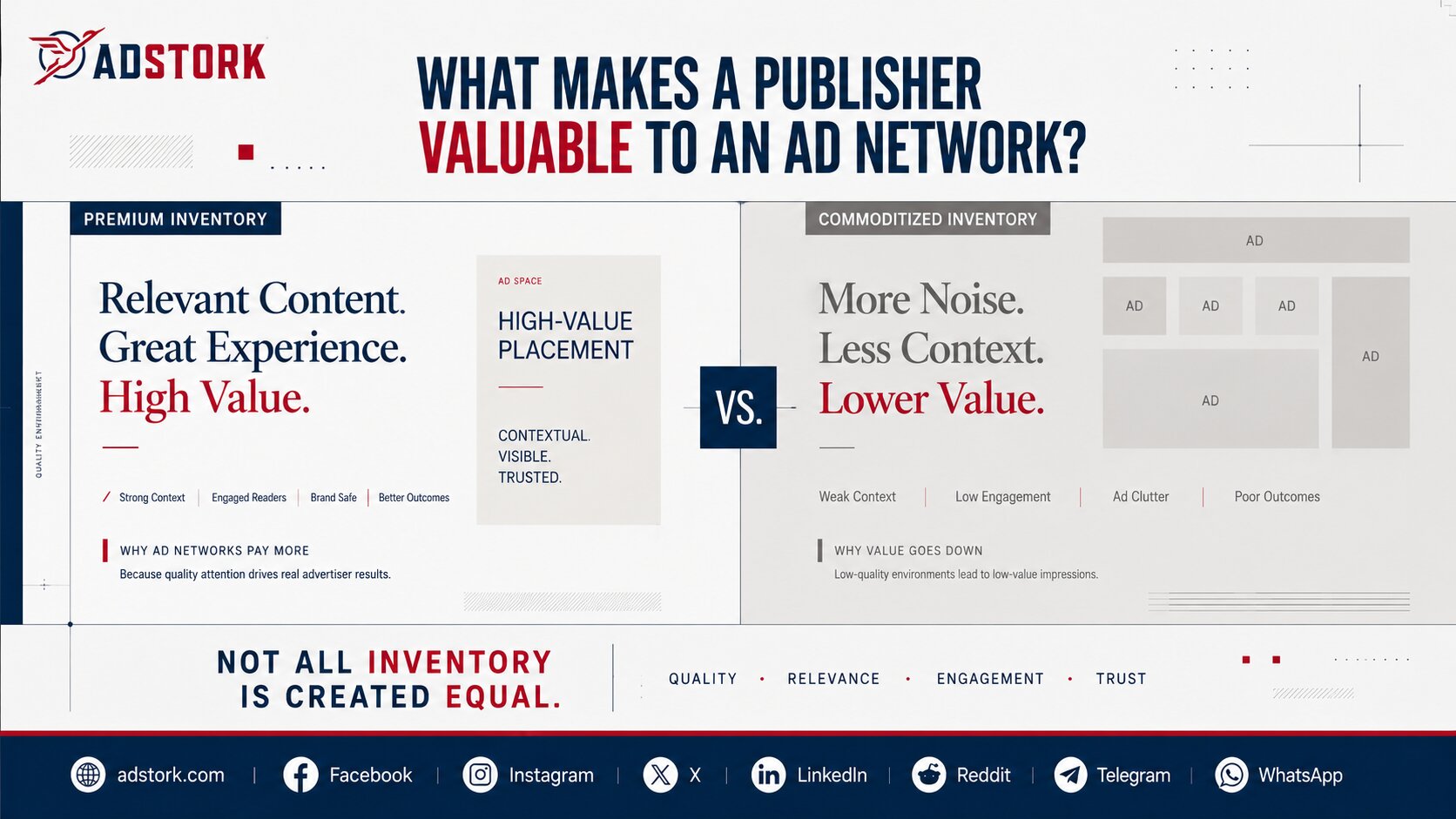
The gap between premium and commoditized inventory is widening. Publishers who clearly communicate why their content and audience experiences are different can protect, and even grow, their yield.
Premium publishers have a unique advantage: they can deliver storytelling environments that naturally drive higher attention and recall. But they need to prove it. Transparency around delivery and ad placement helps buyers see performance differences in black and white, giving them reason to pay a premium.
One major publisher using signal enrichment tools saw a 57% increase in bid response rate, which typically correlates with increased revenue for those ad opportunities. Even incremental improvements in data transparency can translate directly into higher CPMs.
As one industry observer notes, when premium impressions are presented with extensive metadata describing audience characteristics, they are inherently worth more and will attract more buyers, driving up the price.
Understanding your site's value to advertisers is the first step to capturing it. Adstork provides transparent reporting that shows you exactly how advertisers perceive your inventory—audience quality, engagement, viewability, and more. You can see where you score well and where you need improvement. Get a free publisher valuation and discover what your inventory is really worth to advertisers.
Comparison Table: High-Value vs. Low-Value Publisher Inventory
A side-by-side comparison of high-value and low-value publisher inventory across the eight factors.
| Factor | High-Value Publisher | Low-Value Publisher |
|---|---|---|
| Audience Quality | Affluent, loyal, decision-makers | Low income, passive, disengaged |
| Geography | US, UK, Canada, Western Europe | Tier-2 and tier-3 countries |
| Niche | Finance, tech, health, business | General, lifestyle, entertainment |
| Engagement | 3+ min sessions, low bounce, return visits | Under 1 min sessions, high bounce, one-time |
| Consistency | Stable, predictable traffic | Erratic, spike-driven |
| Brand Safety | Clean, reputable, trustworthy | Questionable, low-quality |
| Placement Quality | Above the fold, high viewability | Below the fold, low viewability |
| Traffic Quality | Organic, direct, clean referrals | Incentivised, bot-heavy, suspicious |
| Typical CPM | $8– $18+ | $1 – $3 |
The Competition Effect: Why Quality Attracts More Demand
The value of inventory is not just about what any single advertiser will pay. It is about how many advertisers compete for it. Competition drives pricing.
When multiple buyers actively compete for the same impression, the clearing price rises. Premium inventory attracts more bidders because more advertisers recognise its value. This creates a virtuous cycle: high-quality inventory attracts more demand, which drives higher CPMs, which reinforces the perception of quality.
The number of bids matters since more participants increase the chance of higher prices. The quality of those bids is also critical, as not all advertisers value the same users or formats equally.
Publishers who create inventory that attracts competing bids capture significantly more revenue than those whose inventory attracts only limited interest.
Future Outlook: What Advertisers Will Value in 2026 and Beyond
The factors that determine advertiser value are evolving. Several trends are reshaping what advertisers want from publisher inventory.
First-party data is becoming the currency of trust. Publishers who can offer verified, privacy-safe audience segments provide advertisers with confidence and campaign performance that justify premium pricing. As cookie-based targeting erodes, authenticated audience data becomes essential for maintaining CPMs.
Contextual signals are returning to prominence. With third-party cookies disappearing, advertisers are increasingly relying on content signals to make bidding decisions. Publishers with clear, well-categorised content will benefit.
Brand safety requirements are becoming stricter. Advertisers are demanding more transparency and control. Publishers who cannot demonstrate brand safety will see reduced demand.
Attention metrics are emerging as key signals. Advertisers are moving beyond viewability to measure genuine attention and engagement.
Publishers who invest in quality across all eight factors will be well-positioned for the future.
Advertisers don't buy traffic. They buy audiences, engagement, and outcomes. Understanding what makes your inventory valuable from the advertiser's perspective is the key to unlocking higher CPMs, stronger partnerships, and sustainable revenue growth.
The eight factors—audience quality, geography, niche, engagement, consistency, brand safety, placement quality, and traffic quality—determine how advertisers perceive your inventory. If you score high across these factors, your inventory may be more valuable than your current monetization suggests.
Adstork works with established publishers to help them capture the full value of their premium inventory. If you operate a quality website with engaged audiences, contact our publisher team for a free valuation of your inventory. Let us show you what your traffic is really worth to advertisers.
Your immediate action plan: Audit your site against the eight factors. Where do you score well? Where do you have gaps? Consider how you can improve your weakest factor—whether it is viewability, brand safety, or engagement. Then evaluate whether your current monetization partner is capturing the full value of your premium inventory.
FAQs
What makes a publisher valuable to advertisers? Advertisers value publishers based on eight factors: audience quality (loyalty, purchasing power), geographic location (tier-1 countries command premium CPMs), niche relevance (finance and tech attract higher budgets), engagement metrics (time on site, return visits), consistency (stable, predictable traffic), brand safety (reputable content), placement quality (viewability, ad environment), and traffic quality (clean sources, real users).
Why do advertisers pay more for some publisher inventory than others? Advertisers pay more when they believe an impression is more likely to deliver value—whether that is engagement, brand recall, or conversion. High-quality inventory signals lower risk and higher potential return, justifying higher CPMs.
Does traffic volume or audience quality matter more to advertisers? Audience quality matters significantly more. A publisher with 10,000 engaged, high-value visitors can out-earn one with 100,000 passive, low-value visitors. Advertisers buy audiences, not traffic counts.
How does niche affect advertiser value? Different niches attract different advertiser budgets. Finance, technology, health, and business topics command higher CPMs than general lifestyle or entertainment content. Niche publishers benefit from audience precision and relevance.
What is the impact of brand safety on CPM? Brand safety concerns can reduce CPMs by 50% or more. Advertisers use brand safety filters to exclude unsafe inventory. Sites with clean, reputable content command premium rates.
How can I increase my site's value to advertisers? Improve each of the eight factors: build higher-quality audiences, attract tier-1 geography traffic, create commercial intent content, increase engagement, ensure consistency, maintain brand safety, optimise ad placement for viewability, and maintain clean traffic sources.



Leave a Comment